Proposed Title:
An Efficient AES-GCM Architecture Using Overlap Free Karatsuba GF(2128) Multiplier on Artix-7 FPGA
Proposed Abstract:
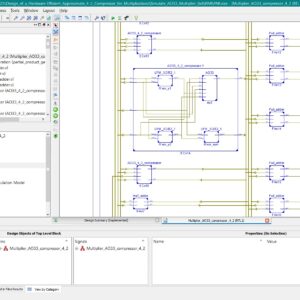
Authenticated encryption plays an important role in modern secure communication systems such as IoT devices, wireless networks, cloud storage, embedded systems, and high-speed data transmission applications because it provides both confidentiality and authentication in a single architecture. Among different authenticated encryption schemes, AES-GCM is widely used due to its high security, parallel processing capability, and low latency operation. However, the GHASH module in AES-GCM introduces high computational complexity and critical path delay because of the GF(2¹²⁸) multiplication process, which limits overall throughput and hardware efficiency in FPGA implementations. Existing works mainly focused on conventional Karatsuba Ofman Algorithm (KOA)-based GHASH architectures and pipelined multipliers, but they still suffer from XOR overlap delay, authentication bottleneck, and higher propagation delay in recursive multiplication stages. To overcome these limitations, this work proposes a high-speed AES-GCM authenticated encryption architecture using a 128-bit overlap-free Karatsuba GF(2¹²⁸) multiplier and a parallel KOA GHASH controller for efficient authentication processing. The proposed architecture also integrates Carry Lookahead Adders (CLA) to reduce arithmetic propagation delay in both AES and multiplier datapaths. In this work, 512-bit plaintext data is processed using four sequential AES-128 encryption operations to improve multi-block encryption efficiency. The major novelty of the proposed work is the integration of overlap-free Karatsuba multiplication, parallel GHASH scheduling, and CLA-assisted datapath optimization into a unified FPGA-based AES-GCM architecture for reduced critical delay and improved throughput performance. The complete architecture was designed using Verilog HDL and synthesized in Xilinx Vivado targeting Artix-7 FPGA. Performance evaluation was carried out based on LUT utilization, timing analysis, operating frequency, throughput, and hardware efficiency, where the proposed architecture achieved high-speed operation at 400 MHz with improved timing performance compared with conventional Karatsuba-based AES-GCM implementations.
” Thanks for Visit this project Pages – Buy It Soon “
An Efficient AES-GCM Architecture Using Overlap Free Karatsuba GF(2128) Multiplier on Artix-7 FPGA
Terms & Conditions:
- Students are advised to watch the project video file output before the payment to test the requirement, correction will be applicable.
- After payment, if any correction in the project is accepted, but the requirement change is applicable with updated charges based upon the requirement.
- After payment, the student having doubts, corrections, software errors, hardware errors, and coding doubts are accepted.
- Online support will not be given more than 3 times. An initial explanation will be given end-to-end from scratch. Also provide recorded video.
- For the first time explanations, we execute all the codings and results in your system, and we record and provide completely with video file support; for the other 2, we can provide doubt clarifications only.
- If there is any issue with the software licence/system error, we can support and rectify that by the end of the day.
- Extra Charges For duplicate bill copies. Bill must be paid in full, no part payment will be accepted.
- After payment, we must send the payment receipt to our email ID.
- Powered by NXFEE INNOVATION, Pondicherry.
Payment Method:
- Pay the Add to Cart Method on this Page
- Deposit cash/check on our account.
- Pay Google Pay/Phone Pay: +91 9789443203
- Send cheque through courier
- Visit our office directly
- Pay using Paypal : Click here to get NXFEE-PayPal link