
Approximate Multiplier for Power Efficiency in FPGA Design Using Internal Self-Healing
Original price was: ₹12,000.00.₹8,000.00Current price is: ₹8,000.00.
Source : Verilog HDL
Base paper abstract:
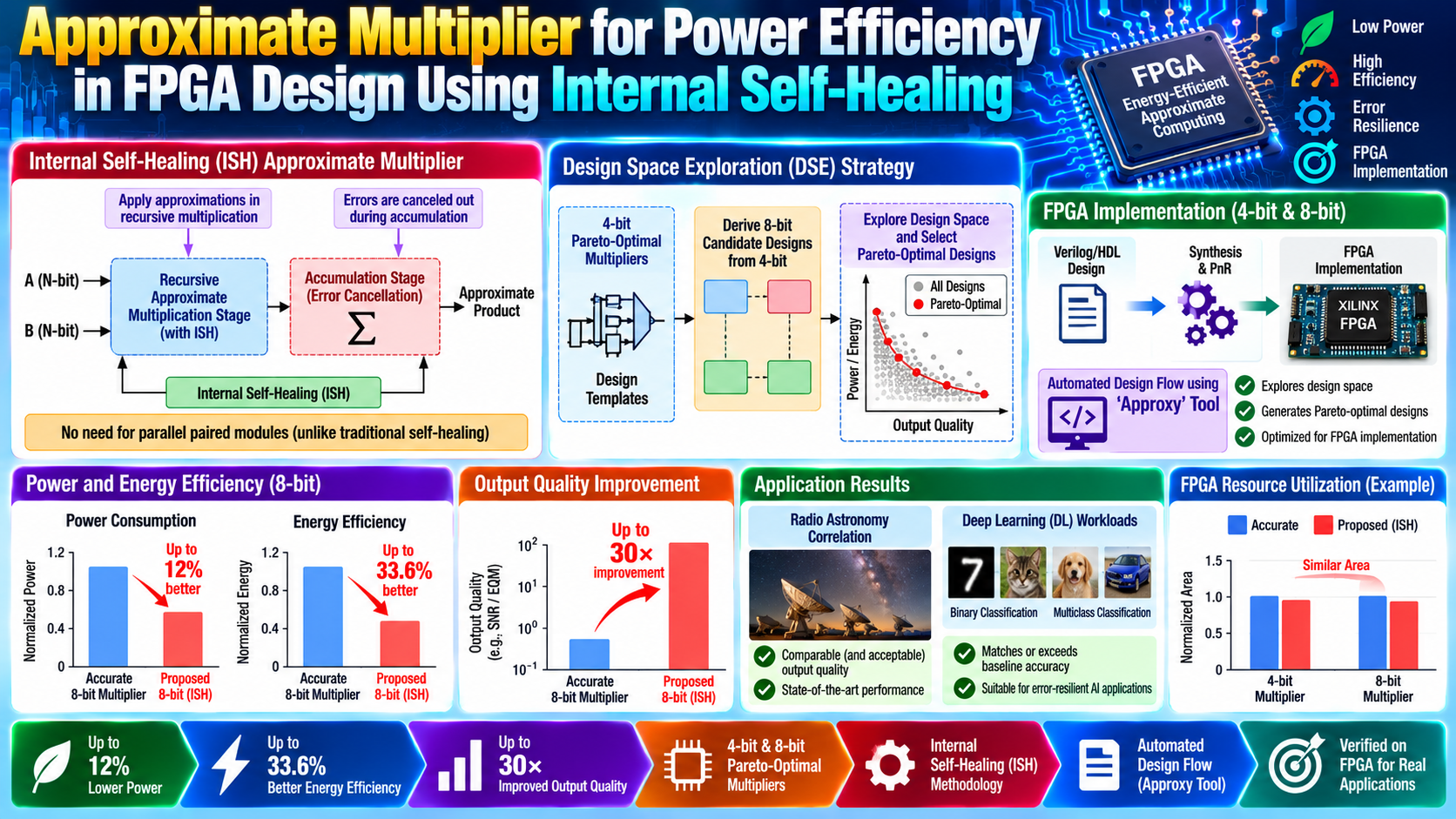
Approximate Computing has emerged as a viable solution to resource constraints in computing for error-resilient applications by relaxing accuracy for significant gains in terms of power, performance, and area. Among existing approximation techniques, the self-healing methodologies have shown a promising quality-efficiency balance by canceling out the overall effect of computational errors. However, they rely on highly parallel implementations for error cancellation. In our prior work (MACISH), we proposed an Internal-Self-Healing (ISH) methodology that applies approximations in the recursive multiplication stage and leverages the accumulation stage for error cancellation, eliminating the need for paired parallel modules required by traditional self-healing approaches. ASIC-based digital designs proposed by MACISH demonstrated superior quality-efficiency results for the radio astronomy application. However, the architectural differences limit the direct mapping of ASIC-based optimized designs to FPGAs. Therefore, this article addresses the gap by designing the FPGA-based Pareto-optimal 4-bit and 8-bit recursive approximate multipliers using ISH methodology. The proposed Design Space Exploration (DSE) strategy manages the vast 8-bit design space by deriving the candidate designs from 4-bit Pareto-optimal multipliers, reducing the search complexity while preserving the performance. The proposed designs achieve up to 12% and 33.6% better power and energy efficiency, respectively, compared to accurate 8-bit multipliers and up to 30× improved output quality at a similar area. The design flow is automated using the ‘Approxy’ Tool, which has also been developed as part of this work. For the radio astronomy correlation application, these designs achieved comparable (and acceptable) output quality with respect to the state-of-the-art. For Deep Learning (DL) workloads, the proposed 8-bit designs matched or even exceeded the baseline accuracy for binary and multiclass classification problems.
List of the following materials will be included with the Downloaded Backup:
Related products
 Approximate Multiplier for Pow...
Original price was: ₹12,000.00.₹8,000.00Current price is: ₹8,000.00.